
2026 NBA Awards Ballot: Shai Gilgeous-Alexander for MVP, Kon Knueppel for Rookie of the Year
 admin_news

For the seventh straight year, the NBA asked me if I’d like to be one the media members with an official ballot for year-end awards. I said yes, and here’s how I decided to use it.
Quick note: I’m writing this before I receive the link to my actual ballot, which won’t come until after the end of the regular season, when the powers that be make their final tabulations on who qualifies under the league’s 65-game threshold for awards consideration. As such, I might need to make a change or two before I click submit.
For the most part, though, here’s what my picks for the 2025-26 NBA regular season will look like:
Most Valuable Player
1. Shai Gilgeous-Alexander, Oklahoma City Thunder
2. Victor Wembanyama, San Antonio Spurs
3. Nikola Jokić, Denver Nuggets
4. Luka Dončić, Los Angeles Lakers*
5. Jaylen Brown, Boston Celtics
In a campaign defined by a pretty phenomenal top four individual talents, all of whom have staked legitimate claim to being the league’s best player at one point or another during this season, I came back to the player I believe has been the best throughout the season: from celebrating ring night by carrying his team to a double-overtime win through nailing down a 60-win season and the top overall seed throughout the NBA playoffs — for the second straight year.
Gilgeous-Alexander is the best player on the NBA’s best team, and the driving force behind the Thunder’s excellence. They’ve won at a 68-win pace in the games he’s played, and have outscored opponents by 16.5 points per 100 non-garbage-time possessions in his minutes — the point differential of a 72-win team. That’s true despite the fact that he has played more than 42% of his minutes with neither of his two best teammates — Jalen Williams, an All-NBA and All-Defense selection last season, and Chet Holmgren, who’s got an excellent chance of earning both of those honors this season — on the floor alongside him. In more than 950 such SGA-solo minutes, Oklahoma City has mopped opponents up by 12.4 points-per-100.
He’s second in the NBA in scoring, shooting 60% on 2-pointers as a guard; he’s producing the second-most-efficient 30-point scoring season in NBA history, behind only 2015-16 Stephen Curry. He’s doing that while dishing assists and avoiding turnovers at a level no high-volume ball-handler has reached since Michael Jordan and peak Tracy McGrady — and while, yet again, grading out as a plus defender on what’s been, yet again, by far the NBA’s best defense.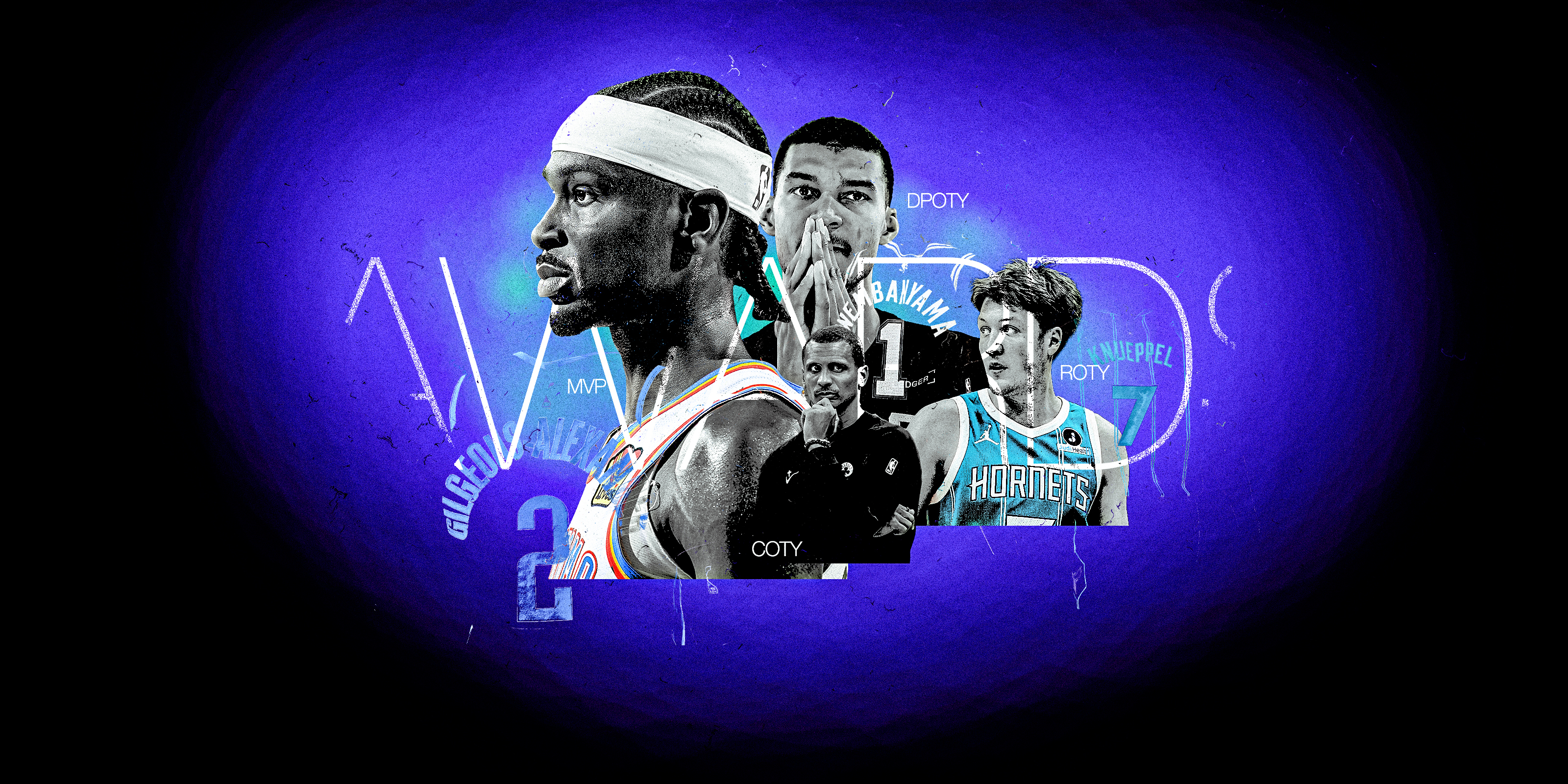
He’s first or second in the NBA in virtually all of the alphabet-soup all-in-one metrics favored by your favorite herb analyst: estimated plus-minus, win shares, value over replacement player, player efficiency rating, box plus-minus, regularized adjusted plus-minus, Jeremias Engelmann’s xRAPM, win probability added, Neil Paine’s LAKER, ESPN’s Net Points, etc. (He also leads the NBA in “clutch” scoring, though I suppose we’ll get to that part later.)
It doesn’t feel like the Thunder have been one of the NBA’s most injured teams this season, even though they have been. (Only Memphis, Portland and Indiana have lost more total player games to injury this season, according to Spotrac’s tracking.) It doesn’t feel like primarily that because, whenever Shai’s around, they feel like the best team in the NBA — and he’s been around in more games than Jokić, and for 420 more minutes than Wembanyama. Add all that up, and it landed SGA at the top of my ballot, putting him in position to become the 16th player in NBA history to win multiple MVP awards.
Second and third were pretty much a coin-flip to me. Jokić continues to stake his claim as the best offensive player on the planet, sitting just outside the top-five in scoring at 27.8 points per game on absurd 57/38/83 shooting splits while also delivering a league-leading 10.9 assists per game to propel the Nuggets back to the No. 1 spot in offensive efficiency. Add in his also-league-leading 12.9 rebounds a night, and the big fella has joined former teammate Russell Westbrook as only the second player in NBA history to average a triple-double in multiple seasons. According to Databallr’s tracking, nobody creates more points per game for his team; nobody more forcefully and significantly elevates his team’s chances of scoring on any given possession.
Wembanyama, conversely, firmly staked his claim this season as the best defensive player on the planet, leading the league in blocks (for the third straight season) and defensive rebounding rate to propel the Spurs to third in the league in defensive efficiency. Other teams barely even look at the rim when he’s stalking the paint: Just 26.1% of San Antonio opponents’ shot attempts have come at the basket with Wembanyama on the floor, which would be the league’s second-lowest mark this season. They score just 38 points per 100 possessions in the paint in his minutes and shoot just 47.4% inside the arc with Wembanyama on the floor, both miles below what the NBA’s worst interior attacks have mustered this season. According to The BBall Index’s tracking, nobody saves more points for his team; nobody more forcefully and significantly reduces the opponent’s chances of scoring on any given possession.
(Oh, and he’s also averaging 24.8 points in 29.2 minutes per game on 51/35/83 shooting splits.)
Most of the aforementioned advanced metrics that Gilgeous-Alexander doesn’t lead (VORP, PER, BPM, DARKO daily plus-minus) have Jokić at the top of the food chain. Wembanyama leads the pack in The BBall Index’s LEBRON, and edges out Jokić in a couple of adjustedplus-minus stats. While both big men dealt with significant injuries earlier in the season, Jokić has played 408 more minutes than Wembanyama — a significant gap that has to be considered as part of this calculus.
So too, though, does just how summarily Wembanyama has dominated that smaller minutes total. The Spurs have outscored opponents by 17 points per 100 possessions with Wemby on the floor — the highest net rating of any player to log at least 60 games, just ahead of SGA’s 16.3 — and have gone 49-14, a 64-win pace, with him in the lineup. The Nuggets have still been great with Jokić in the middle, but not quite that great: a +10.8 net rating and a 42-22 record, a 54-win pace, in his appearances.
To me, that gap — which neatly tracks the Spurs’ nine-game edge over the Nuggets in the Western Conference standings — is enough to overcome the minutes gap and nudge Wembanyama ahead into my No. 2 slot. While we shouldn’t become inured to how remarkable Jokić is and continues to be, Wembanyama’s arrival as not merely an ascendant talent but one eminently ready to make a massive impact on the chase for the championship stands as perhaps the biggest story in the NBA this season. That merits recognition and, in my eyes, a little bit of a boost. Jokić takes third.
I touched on the high points of the case for Dončić’s candidacy last week, in writing about the impact of the left hamstring injury that prematurely ended his regular season. I’m keeping him in fourth for now, pending the resolution of his challenge to the 65-game rule; there’s been no such challenge for Cade Cunningham or Anthony Edwards, so they wind up on the outside looking in. (Cunningham definitely would’ve been on my ballot if he hadn’t suffered a punctured lung with three weeks left in the season and I was able to select him.)
Tom Haberstroh and I considered several different options when we discussed the fifth spot on the ballot on a recent episode of The Big Number. Advanced numbers like EPM, LEBRON, DARKO, VORP and PER point toward Kawhi Leonard; he’s top-five in all of them, and has been sensational in shepherding the Clippers’ gargantuan turnaround following their disastrous 6-21 start. He’s averaging a career-high 28 points per game on 50/39/89 shooting, leading the NBA in points per touch (minimum 50 games played) while being just off the league lead in steals and just outside the top 10 in deflections; the Clippers have the point differential of a 59-win team when he’s on the court, and have won at a 47-win pace (37-27) with him in the lineup.
That disastrous start did happen, though, and while Leonard missed a chunk of it dealing with ankle and foot sprains, he didn’t miss all of it. The Clippers went 4-13 with him in the lineup during that stretch, which featured some of the most rancid vibes in the league as the franchise remained — and, lest we forget, remains — mired in the ongoing investigation into whether or not owner Steve Ballmer deliberately sought to circumvent the salary cap by funneling tens of millions of dollars to Leonard through an endorsement deal. None of that’s enough to keep Leonard off the All-NBA team; it did, however, leave me looking elsewhere on my MVP ballot.
Brown doesn’t have nearly the advanced statistical case that Leonard and some other candidates do. What he does have, though, is a damn good regular statistical case — Brown joins Dončić as the only players averaging at least 28 points, seven rebounds and five assists per game this season — while shouldering a mammoth offensive workload as the pressed-into-duty No. 1 option for a Celtics team that ranks second in the NBA in points scored per possession and has blown past 50 wins en route to second place in the East.
50 wins in a gap year ☘️— Jaylen Brown (@FCHWPO) March 30, 2026
The arguments against Brown’s case tend to start with the numbers that say that the Celtics have been nearly twice as good with Brown off the floor (+11.5 points-per-100) as on it (+6.1), and the various metrics that routinely point the credit for Boston’s fantastic season elsewhere — to how they generate extra possessions with elite offensive rebounding and steady-handed turnover avoidance, how they win the math battle on the margins by creating a ton of 3s on offense and limiting shots at the rim on defense, to the no-stats-All-Star two-way magic of Derrick White, to the brilliance of Brad Stevens in finding contributors where no one else saw them and of Joe Mazzulla in coaching them up, etc. I’m open to those explanations; it feels at least a little bit like missing the forest for the trees, though.
Maybe the many young Celtics who have seized their opportunities and thrived have been able to do so because of Brown’s reliable presence as a source of mega-volume, reasonable-efficiency offense; of relentless, lead-the-league-in-drives rim pressure to suck in the defense; of persistent help on the boards and sound perimeter defense across multiple positions. Maybe a lot of what has made the Celtics special this season has been able to exist not in spite of Brown soaking up possessions and dragging down efficiency, but because they’ve had that constant at the center of the frame. That’s my take, anyway.
I don’t think that’s enough to elevate Brown over the likes of SGA, Wemby, Jokić or Dončić. For fifth place, though? I think that’s fine.
Also in consideration: Cunningham, Leonard, Edwards, Donovan Mitchell, Tyrese Maxey.
Defensive Player of the Year
1. Victor Wembanyama, San Antonio Spurs
2. Chet Holmgren, Oklahoma City Thunder
3. Ausar Thompson, Detroit Pistons
I hit on a lot of the key elements of Wembanyama’s candidacy in the MVP section. He is an extinction-level event for your offense’s best-laid plans, night in and night out; with him on the floor, the Spurs allow 104.8 points per 100 non-garbage-time possessions, according to Cleaning the Glass, which is more than two points-per-100 stingier than the NBA’s best full-season defense.
That NBA-best-full-season defense belongs to Oklahoma City, and it’s anchored by Holmgren. With him patrolling the back line, the Thunder allow an even more microscopic 103.3 points-per-100, holding opponents to league-best 57.5% shooting at the rim. Drill down into just the plays where Holmgren is the nearest defender, and OKC opponents have converted just 47.7% of their up-close tries, according to Second Spectrum tracking — comfortably the best number of any player who’s appeared in at least 60 games.
Holmgren’s a menace as a helper on the weak side, he’s adept at eating space and taking away options when guarding the pick-and-roll, and he’s a more-capable-than-you-might-think defender in space on switches (though he doesn’t get asked to do that much in OKC’s scheme). Yes, he has the benefit of being flanked by excellent perimeter defenders like Luguentz Dort, Cason Wallace and Alex Caruso. But he deserves plenty of credit in his own right for serving as the backbone of a unit that — whether he’s shared the floor with Isaiah Hartenstein or Jaylin Williams, or manned the 5 spot solo — has consistently defended at best-in-the-league levels.
After recognizing 7-foot-plus rim protectors with the first two spots, I tip the cap for third to Thompson, who I think has been the best perimeter defender in the league this season — the point-of-attack ace at the tip of the spear for Detroit’s No. 2-ranked defense.
Thompson is tied for the league lead in steals and deflections per game, and trails only Wembanyama in defensive estimated plus-minus and stop percentage — a measurement of the share of possessions where a defender comes away with a steal, a block recovered by the defense or an offensive foul drawn. Thompson’s length, foot speed, lateral quickness, explosive athleticism and dogged resistance to being screened makes him an unnerving mirror image for opposing offensive weapons; according to The BBall Index’s tracking, he is the only player in the NBA this season to grade out as a 90th-percentile-or-better performer in defensive playmaking (read: creating events like steals, blocks and deflections), points saved, passing lane defense, perimeter isolation defense and coverage versatility — all while checking the absolute best of the best every single night.
Also in consideration: Rudy Gobert, Bam Adebayo, Scottie Barnes, Derrick White.
Rookie of the Year
1. Kon Knueppel, Charlotte Hornets
2. Cooper Flagg, Dallas Mavericks
3. VJ Edgecombe, Philadelphia 76ers
I think two things can be true: that the breathtaking breadth of tools that Flagg has displayed over the course of what’s broadly been a pretty disastrous season in Dallas indicate he’s going to be one of the best all-around players in the NBA before too long; and that Knueppel has had, on balance, the better rookie season.
Reasonable people can disagree on that, and I’m not going to start a fistfight over it. We’ve yet to see Flagg surrounded by the kind of talent that flanks Knueppel in what’s been the NBA’s best big-minutes starting lineup this season. Even while playing out of position as a point guard with hardly any shooters around him early in the season, Flagg still found ways to get to his spots to create and knock down tough shots, still competed on defense and on the glass, still showed exactly why he was such a prized product coming out of Duke.
Being the eighth rookie ever to average 20 points, six rebounds and four assists per game — and just the second teenager ever to do it — is nothing to sneeze at. Nor is the fact that he’s got a rookie-class-high 10 30-point games (twice as many as Knueppel), four 40-point outings, and one of just 17 50-point performances across the league this season. What Flagg has done as Dallas’ de facto but ultimately unquestioned No. 1 option is, inarguably, awfully impressive.
But so, too, is walking into the NBA as one of the best shooters in the world — someone capable of leading the entire league in 3-pointers while shooting 43% on all that volume; an elite off-the-bounce, off-the-catch, on-the-move, any-way-you-want-it marksman whose presence opens up acres of space for his teammates and immediately transformed one of the league’s most moribund offenses into one of its most fearsome attacks.
So is being able to contribute enough beyond that floor-spacing — shooting 65% at the rim and 47% from midrange, posting a top-20 rebounding rate for a small forward, sprinting into screens for LaMelo Ball and Brandon Miller to unlock Charlotte’s devastating guard-guard pick-and-roll game, serving as a quick-decision short-roll playmaker, dishing four assists per 36 minutes, etc. — that you become an immediate 30-plus-minute-a-night starter for what’s been one of the best teams in basketball for the past 50-plus games.
Casting this as simply a case of prioritizing efficiency over ability gives short shrift to Knueppel’s skills. If it was easy to just make at least 50 catch-and-shoot 3s and 50 pull-up 3s while shooting better than 40% on both, there would probably be more than four people doing it this season (Knueppel, AJ Green, Cam Spencer, Jamal Murray). If it was easy to do that while also shooting 55% on 2-pointers, more than none of those guys would be doing it. If it was easy to shoot as well from deep as Knueppel has, on as high a volume of launches, while commanding as large a share of his team’s offense, there would probably be more than three other people in NBA history — Stephen Curry, Klay Thompson and Buddy Hield — who have done it.
Would Knueppel’s numbers look as good if he’d been the one in Flagg’s spot, tasked with doing more while surrounded by less? Probably not. (Although, for what it’s worth, Charlotte has outscored opponents by a healthy 5.2 points-per-100 in 800 minutes of Knueppel playing without either Ball or Miller, and Knueppel has averaged 30.5 points and 5.9 assists per 100 possessions on .600 true shooting in more than 1,000 minutes without LaMelo on the floor, according to PBP Stats.) But you go with the facts you have, not the counterfactuals you imagine, and in the season we’ve just witnessed, Knueppel led the rookie class in virtually every advanced metric there is (and led Flagg in all of them except PER), averaged 18-5-3 on nearly .640 true shooting while becoming the first rookie ever to lead the NBA in 3-pointers, did it while being a constant for a playoff (or, at least, play-in) team playing meaningful basketball down the stretch, and did it while playing a dozen more games and nearly 200 more minutes than Flagg.
Knueppel gets my vote. Flagg gets second. Edgecombe — averaging 16 points, 5.6 rebounds, four assists and nearly two stocks per game as, like Knueppel, a Day 1 starter expected to hold his weight next to Maxey for a postseason team, and doing it while playing nearly 1,000 more minutes than the also-awesome-but-coming-off-the-bench Harper — takes third.
Also in consideration: Harper.
Coach of the Year
1. Joe Mazzulla, Boston Celtics
2. J.B. Bickerstaff, Detroit Pistons
3. Mitch Johnson, San Antonio Spurs
As ever, there are more qualified candidates for this award than there are spots on the ballot. In lieu of an All-Coaching Team, I went with Mazzulla in recognition of the Celtics blowing away everybody’s expectations by not only staying afloat without Jayson Tatum, Jrue Holiday, Al Horford and Kristaps Porziņģis, but thriving.
Without its best player and half of its championship-winning core, Boston stayed true to its core principles — no turnovers, no fouls, control the boards, protect the rim, get back in transition, bomb 3s — and flourished. Fifty-four wins (and counting), the East’s second-best record and a tie for its best net rating, the NBA’s No. 2 offense and No. 5 defense, and a whole new crop of hungry contributors — Neemias Queta, Jordan Walsh, Hugo González, Baylor Scheierman, Luka Garza, Ron Harper Jr. — rising up to meet the moment and seize their opportunities.
The eminently quotable Mazzulla can call this a stupid award, because it’s the players that have ultimately done the work, all he wants. But these players — the young and previously overlooked ones, especially — have been developed and prepared to do so, and it seems reasonable to recognize the dude responsible for fostering that preparation and development. These Celtics are relentless; attitude reflects leadership. Sorry for the trophy, Joe.
Bickerstaff, the 2024-25 runner-up, deserves a ton of credit for building on last season’s mammoth turnaround in Detroit, leading the Pistons to just outside the top 10 in offensive efficiency and all the way up to second on the defensive end on their way to the East’s best record and the franchise’s best season since 2008.
The third spot goes to Johnson, who, yes, benefits from the chance to coach an alien, but has also aced the difficult task of getting everyone to buy into what he’s selling: coming off the bench (Keldon Johnson, Harrison Barnes), accepting fewer shots and touches (De’Aaron Fox), being the third man in the rotation despite being the second pick in the draft (Dylan Harper) and defending like your life depends on it (everyone). You can’t win without the talent, but you also have to give the talent a reason to believe. Johnson’s done that, and the result is a 60-win season that nobody saw coming.
Also in consideration: Charles Lee and Jordan Ott, both of whom changed the cultures in their respective cities, leading Charlotte and Phoenix back to postseason play and respectability with breath-of-fresh-air competitiveness and a brand of ball worth watching.
Sixth Man of the Year
1. Keldon Johnson, San Antonio Spurs
2. Jaime Jaquez Jr., Miami Heat
3. Tim Hardaway Jr., Denver Nuggets
The arrivals of Victor Wembanyama, De’Aaron Fox, Stephon Castle and Dylan Harper meant that Johnson no longer had to be a primary offensive option for a team with few other pathways to points, as was often the case during the Spurs’ fallow period. Instead, the best way to balance the books for the San Antonio rotation would be for him to accept a move to the bench, where he’d be able to act as an instant temperature-changer in the second unit who could immediately check in and attack. He’s proven incredibly well suited to the task, playing arguably the best ball of his seven-year NBA career — 13.1 points, 5.4 rebounds and 1.4 assists in 23.3 minutes per game off the bench, shooting a career-best 60% on 2-point shots and 36.5% from beyond the arc.
Johnson throws his body around, fighting for boards and diving for loose balls with the right kind of reckless abandon. He’s skilled enough to serve as an offensive hub for the reserve corps, facing up to take slower defenders off the bounce or backing down smaller ones on mismatches in the post. He’s also perfectly comfortable slotting in as a complementary piece alongside the Spurs’ starters as matchups dictate, taking advantage of the attention his teammates demand by cutting into space or driving past a closeout toward paydirt. He’s just always charged up — one reason among many that San Antonio has been one of the league’s most electric watches this season.
Jaquez has had a sensational bounce-back season in Miami, fitting perfectly into the spread-the-floor-and-drive-and-kick attack that Erik Spoelstra instituted and reaping the benefits to the tune of career-best production. The third-year pro leads all primary reserves in scoring at 15.1 points per game on 50% shooting, while also pulling down 5.1 rebounds and dishing 4.7 assists a night. He consistently pressured the rim, ranking just outside the top 10 in drives per game and in the top 30 in points in the paint per game among players to log at least 50 appearances this season. Johnson scored more efficiently on his drives, inside the arc and from long distance, which helped tip the scale in his favor, but Jaquez has inarguably been one of the league’s premier reserves — and may well top a lot of ballots.
I rounded out my ballot with Hardaway, who’s proven a hand-in-glove fit as a neon-green-light shooter next to Nikola Jokić and Jamal Murray in Denver. The 13-year vet has shot a career-best 41% from 3-point range on nearly seven attempts per night, providing vital release-valve buckets and complementary offense for a team that has seen virtually its entire rotation besides Murray miss significant time due to injury. He’s a steady pair of hands that knows his job description and nails it; he lets it fly, moves it when he doesn’t have it, and doesn’t cough it up, committing a grand total of 43 turnovers in 2,100 minutes. The Nuggets have outscored opponents by 5.3 points-per-100 in his minutes — just what the doctor ordered off the Denver bench.
Also in consideration: Isaiah Stewart, Naz Reid, Reed Sheppard, Jordan Goodwin, Jamal Shead, Ajay Mitchell (and any of like five other dudes on the Thunder bench).
Most Improved Player
1. Nickeil Alexander-Walker, Atlanta Hawks
2. Jalen Duren, Detroit Pistons
3. Neemias Queta, Boston Celtics
Alexander-Walker had already saved his career; after underwhelming fits-and-starts tenures in New Orleans and Utah, the play he turned in over the course of two-plus seasons in Minnesota had firmly established him as a bankable two-way reserve, someone capable of serving as a high-level role player alongside brighter talents. What he’s done since arriving in Atlanta, though, has suggested the possibility of an entirely new career as the 27-year-old hits his prime: one in which he is that brighter talent.
I feel pretty confident in saying that this isn’t just a case of “he got more minutes and more shots, so he put up better numbers.” OK, sure, yes, that has happened; Alexander-Walker has more than doubled his scoring (20.9 points per game, up from 9.4 last season with the Wolves) with significant increases in minutes per game, field goal attempts, usage rate, touches per game and time of possession. But it’s not just that.
That offensive explosion has happened not just because of an uptick in volume, but because Alexander-Walker appears to be have gotten better at damn near everything: from scoring in transition and knocking down spot-up jumpers to running the pick-and-roll, screening and making plays in space, operating in the dribble handoff game, attacking in isolation, finishing on his drives, getting to the line and, perhaps most notably, knocking down 3s. Before this season, NAW’s best long-distance campaign had seen him shoot 39.1% on 6.3 attempts per 36 minutes; he entered Wednesday’s action at 39.9% on 8.7 attempts per-36. The only other player in the NBA this season shooting that much and knocking ‘em down that often while scoring 20 a night? Alexander-Walker’s old Minnesota teammate, Anthony Edwards.
Making that kind of offensive leap seven years deep is rare; doing so while remaining a plus backcourt defender on what’s been one of the best teams in the NBA for the past few months is even rarer. Getting Alexander-Walker for less than 10% of the salary cap seemed like a really good deal at the time. Now, it looks like a flat-out steal.
So, for that matter, does landing a franchise center with the 13th pick in the draft.
Already entrenched as a solid, double-double-averaging starter for an ascendant Pistons team, Duren has made significant leaps on both ends of the floor this season. He has maintained elite finishing efficiency on a higher workload while creating more of his own offense, and sharply curbed his turnover rate despite handling the ball more. He’s also cut down his foul rate, allowed a lower defensive field goal percentage while contesting shots at the rim, and been a stouter stopper when guarding the pick-and-roll — all integral components in Detroit’s elite defense.
The work he put in while partnering with Cade Cunningham in the first half of the season earned him his first All-Star nod. The work he’s continued to put in since, headlined by the 23.3 points per game he averaged while Cunningham was sidelined, may well earn him an All-NBA selection — and, possibly, a spot atop a lot of MIP ballots.
I thought about going a lot of different ways with the third spot. Like Duren, Deni Avdija and Jalen Johnson made the leap to All-Star and possible All-NBA status; whereas Duren’s big jump on both ends came primarily within the space of this season, though, Johnson and Avdija’s big years felt more like just extensions of growth they’d previously shown. (In fact, both have made my “also receiving consideration” lists for MIP in previous years: Johnson in 2023-24, Avdija in both ’23-’24and’24-’25.)
While some view the leap from starter to All-Star/All-NBA as perhaps the hardest to make in the league, going from “on the fringes of the league on two-way deals to firmly proving you belong in a team’s future plans” is no picnic, either. That’s exactly what Ryan Rollins did, building on the opportunity he earned late last season on the way to across-the-board career highs. Rollins joined All-Stars Jamal Murray and Darius Garland as one of just three players to average 17 points and five assists per game while shooting 40% from 3-point range this season, and did so while ranking in the top 10 in steals and deflections per game — a rare, notable bright spot amid a grim season in Milwaukee.
The overall picture’s brighter in Phoenix, thanks in part to the exceedingly pleasant surprise of Collin Gillespie — undrafted in 2022, logging a grand total of 225 NBA minutes over the course of his two-way contracts in Denver, stuck at the end of the bench on last season’s haunted Suns roster — asserting himself as an Energizer battery with a ratchet (40% from 3-point range on more than seven attempts per game), a steady pair of hands (a near 3-to-1 assist-to-turnover ratio) and a competitive snarl (no less an evaluator than Dillon Brooks, almost immediately after arriving in Phoenix, pronounced him “Villain Jr.”). There’s plenty of credit to go around for the Suns’ year-over-year transformation into a physical, defense-first, hard-nosed, hyper-competitive team; Gillespie deserves his fair share of it.
In the end, I decided to go with Queta — another player who not only worked his way from the fringes of the league into a more prominent role when given an opportunity, but seized that chance to become one of the league’s most productive players at his position this season.
The Portuguese big man out of Utah State had barely played since entering the league in 2021, logging just over 1,300 minutes across four seasons spent mostly at the end of the bench — first in going-nowhere Sacramento, then in competing-for-championships Boston, where he saw scant minutes behind the likes of Horford, Porziņģis and Luke Kornet. When all of them left in free agency, plenty of us wondered how the Celtics planned to replace them without getting absolutely destroyed on the interior. The answer, it turned out, was Queta, who immediately became one of the league’s best offensive rebounders and pick-and-roll dive men, as well as a strong defensive presence at the rim (sixth in the NBA in block percentage, right between Donovan Clingan and Evan Mobley, and holding opponents to 57.2% on point-blank tries he’s defended).
A year and a half ago, only true sickos even knew Queta’s name. Now, he’s the starting center on one of the best teams in the NBA. Pretty solid glow-up, if you ask me.
Also in consideration: The aforementioned Avdija, Johnson, Rollins and Gillespie. Keyonte George would’ve factored in if he’d played 65 games.
Clutch Player of the Year
1. Shai Gilgeous-Alexander, Oklahoma City Thunder
2. Jamal Murray, Denver Nuggets
3. Tyrese Maxey, Philadelphia 76ers
This one didn’t feel too hard. SGA leads the NBA in points scored in the final five minutes of close-and-late contests, shooting 51.5% in those situations with a 3-to-1 assist-to-turnover ratio; on shots with a chance to either tie or take the lead in crunch time, he’s shooting 55%. Murray’s second in clutch scoring, shooting 52.2%, and while he’s got more than double Shai’s turnovers, he’s also got 10 steals-plus-blocks in crunch time, which is a nice way to mitigate those miscues.
Drill down into the final two minutes of the fourth and OT, and nobody’s hit more shots to tie or take the lead than Maxey, who’s 27-for-49 (55.1%) on those gotta-have-’em shots — particularly vital buckets for a Sixers team that, in accordance with the intractable cosmic laws governing this reality, has once again been down multiple starters for more than half the season, and has needed every win it can scrounge up just to have a shot at escaping the play-in as the regular season draws to a close.
Also in consideration: Jalen Brunson, Nikola Jokić, Anthony Edwards, Desmond Bane.