
With CFP expansion talks ongoing, presidential committee pushing for 24-team field
 admin_news
DALLAS — This week, members of the College Football Playoff governance committee — the 10 FBS conference commissioners and Notre Dame’s athletic director — gather here at their annual spring meetings, pitted in a room for more than 15 hours over two days with the responsibility to govern the industry’s most valuable product.
For more than a decade now, the committee has lived beneath the cloud of a never-ending discussion over postseason expansion — from two teams to four to the current iteration of 12 and, now, the year-long public spat over the next edition of the CFP: 16 or 24.
Through the years, like an invisible fog, the argument lingers, having survived the job term of the committee’s own participants.
But as meetings begin here this week, something altogether new has surfaced.
The CFP committee is not the only group of highly placed executives taking an interest in playoff expansion.
“We asked the government for help with NIL,” said one CFP committee member recently, “and now they’re involved in the playoff.”
Is Congress and the federal government prying into the College Football Playoff?
Not exactly.
However, a 14-person presidential “media” committee — its existence supported by the White House — is holding real conversations about the future of the postseason.
In fact, in a fascinating discussion that unfolded last week, the presidential committee identified a variety of ways that the industry can generate more revenue to help financially stressed schools.
One of those: Expand the playoff to 24 teams.
“I think it’s accurate to say that there is a coalescing around 24,” said one high-placed stakeholder who is part of both the CFP governance committee and the presidential group. The 2026 College Football Playoff format is locked in. But it could change to 16, 20 or even 24 teams in the future. (Peter Joneleit/Getty Images)

There is a crossover between the two. The 14-person presidential committee includes commissioners of the Big 12, Big Ten, SEC, ACC and American, plus Notre Dame’s athletic director — all of them CFP decision-makers.
Other members of the presidential committee include ESPN and Fox executives; business magnates like Gerry Cardinale and David Blitzer; Boris Epshteyn, a Republican political strategist and long-time adviser to President Donald Trump; and the committee chair, Cody Campbell, the Texas billionaire and close ally to Trump who’s leading a federal campaign to overhaul college sports along with New York Yankees president Randy Levine.
The growing support for a 24-team playoff not only exists among those presidential committee members working outside of college athletics.
During last week’s meeting, at least three of the four power conference commissioners, and Notre Dame, expressed outright support for, or at the very least an openness to deeply explore, a 24-team proposal, those with knowledge of the meeting told Yahoo Sports.
Noticeably absent from the call was the SEC commissioner, Greg Sankey.
Big Ten vs. SEC
The presidential media committee does not hold authority over changes to the playoff. That power lies with the Big Ten and SEC — two leagues bequeathed such authority by the other conferences two years ago. In fact, the presidential committee's role is only to eventually arrive at recommendations to the White House that may inform a congressional bill.
But emerging from its meetings — two have been held so far — is a movement from commissioners toward a 24-team playoff format that stands to generate hundreds of millions in additional dollars, completely reshape the sport’s regular season and postseason, and perhaps even alter the course of the industry as a whole.
It’s a stark change for a group that as recently as January supported an SEC-backed 16-team format — an expansion attempt that the Big Ten stifled in favor of its own 24-team concept.
Just three months later, are CFP governance members now aligning behind the 24-team model? Perhaps.
It doesn’t change a straightforward fact: The SEC and Big Ten must agree for the CFP to adopt a new format.
As it turns out, on Wednesday here, the CFP has allotted a large chunk of time to discuss playoff expansion, though no decision is expected this week (the 12-team postseason will remain at least for this year).
Among the SEC’s football coaches and athletic directors, there are public and private signals of support for a 24-team playoff. In fact, some believe a majority of each of those groups would be in favor of such, as well as the elimination of the league’s conference championship game — the latter of which even Alabama athletic director Greg Byrne and Georgia coach Kirby Smart voiced publicly last month. Fernando Mendoza and the Indiana Hoosiers won the 2026 College Football Playoff — the third consecutive championship for a Big Ten team. (Jamie Squire/Getty Images)
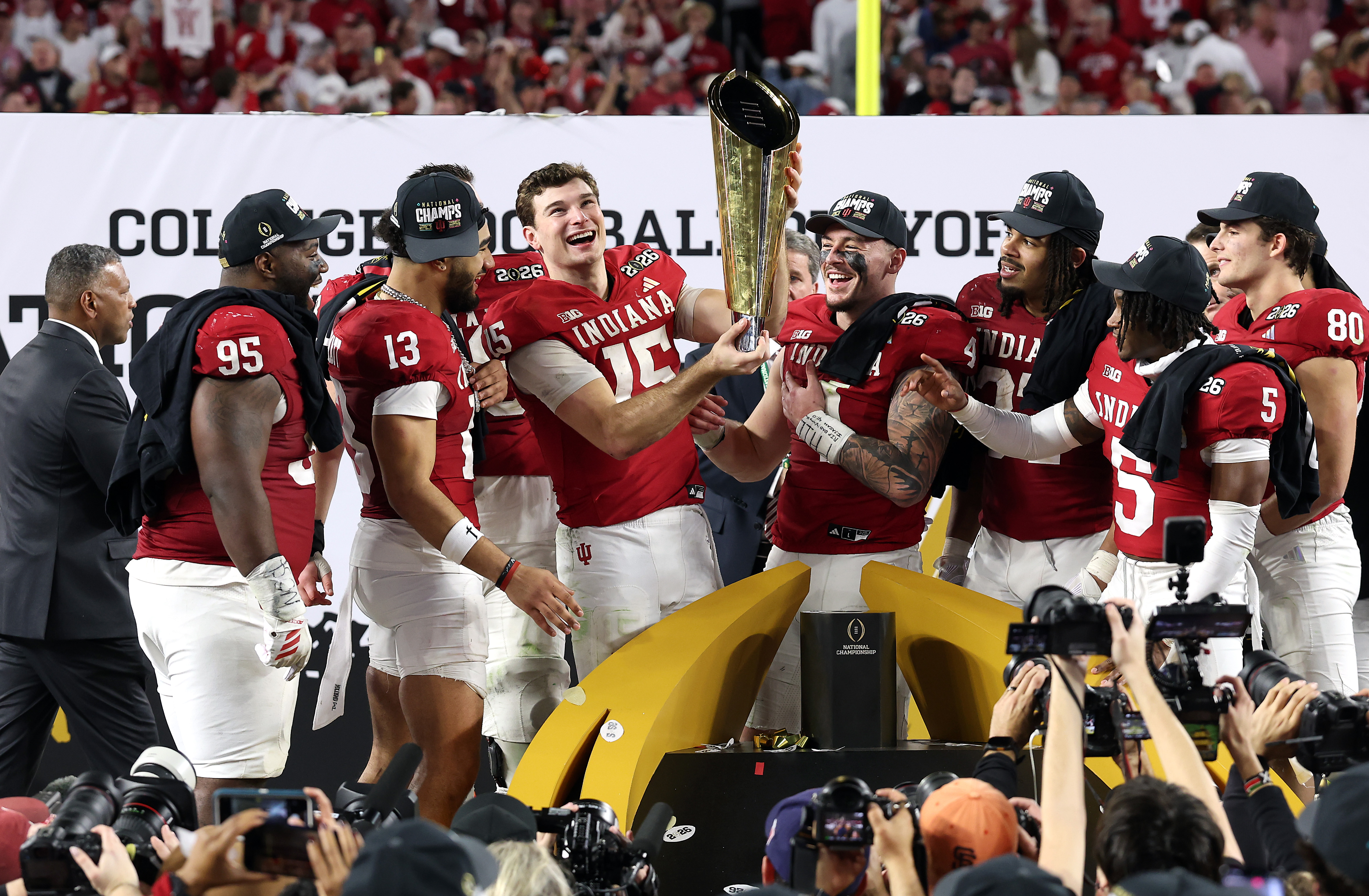
Frustrations brew over the league’s decision last year to move to a nine-game conference schedule — a move that many within the conference assumed would result in playoff expansion.
“The expectation of every athletic director in the SEC was that at some level, the nine-game schedule was going to be combined with at least a 16-team CFP field,” Auburn athletic director Cohen told AL.com.
Ole Miss chancellor Glenn Boyce told 247Sports that he would not have voted in favor of adding a ninth game if he knew expansion wouldn’t arrive. “I would’ve said no,” he told the outlet.
The room in which Boyce is a part of — the 16 SEC presidents and chancellors that Sankey works for — is mostly rooted in long-standing traditional methods and values. Over the last 18 months, various presidents, as well as Sankey himself, have voiced their support for a 16-team postseason format as a way to ease into expansion, retain what is a valuable conference championship game (upwards of $80 million annually) and preserve the most-watched entity in the sport: the SEC’s regular season — something oh-so important for any renegotiation of the league’s television deal.
But as programs spend more than $30 million on their football rosters, the desire for more access — and more money — becomes stronger (this is happening with the push to expand the NCAA basketball tournament as well).
“I think 24 teams is good for the fan bases,” Smart said earlier this spring. “I think when coaches and ADs look at it, we're looking at our fan bases having an expectation that they want to be in the playoffs — it's playoffs or bust.”
The playoff pitch
The Big Ten’s playoff pitch has changed over time, evolving to perhaps garner necessary support, not unlike Congress tweaking legislation to arrive at a majority for passage.
It started two years ago in the spring of 2024, when conference commissioner Tony Petitti privately unveiled to some CFP governance committee members the idea of a 16-team format with uneven automatic qualifiers for the power leagues (four each for the SEC and Big Ten; two each for the ACC and Big 12; one for the Group of Six; and three at-large).
Though supported by plenty of SEC athletic directors, the concept was met with resistance from most other CFP members. It died last May when enough of the league’s football coaches, during their annual spring meetings in Destin, spoke against the format — most notably Smart — and chose instead to swing support behind a 16-team model with a bigger at-large pool.
Months later, last fall, the Big Ten’s concept shifted to a 20- or 24-team model with an equal number of automatic qualifiers for each of the power leagues. And then, most recently, the league socialized an option for an all at-large 24-team format with a potential path for an automatic Group of Six bid, too.
In the most discussed model — the one at the center of the presidential committee’s latest talks — the 24-team field relies mostly on CFP rankings, grants first-round byes to the top eight teams and plays the first two rounds on campus before the six CFP bowls host quarterfinals and semifinals.
While the concept features just one additional round, it adds 12 total games, more than doubling the current 11-game CFP field — perhaps a way to recuperate the financial loss of the power four conference championship games (what many estimate to be a $150-200 million value).
But detractors of a 24-team field scoff at lofty financial projections for an additional 12 games that, in many cases, will include three and four-loss teams.
Are these really that valuable?
Last year, for instance, 8-4 Iowa would have played at 10-2 Miami in the first round, and 10-2 Vanderbilt would have hosted 10-3 Virginia. Three-loss teams like Georgia Tech, Houston and Michigan would have advanced into the field, too.
Those against such a format describe it as devaluing what has forever been college football’s most cherished item: the regular season.
While supporters of the 24-team field believe that November conference games get a boost in value, detractors argue that September non-conference games aren’t as meaningful. But those in support of a 24-team field believe that administrators will be more willing to schedule high-level, revenue-generating, non-conference matchups as the penalty for a loss isn’t as severe in a format where a third or even fourth loss doesn’t mean elimination.
“I think 24 solves an enormous amount of problems,” said Fox Sports CEO Eric Shanks last week from the Sports Business Journal’s World Congress of Sports. “You can create (A) more valuable games that the schools need, but (B) one of the big knocks against college football is the first three weeks. It’s actually hard to find great games.”
While Fox executives have been public about their support for a 24-team field, ESPN executives have privately dismissed the notion. ESPN currently possesses the rights to the 12-team playoff for the next six years and though it may hold first right to bid on additional games, would the network do so? It has already sublicensed 15 playoff games to TNT Sports over the next six years.
Notably, the Big Ten and SEC’s playoff preferences align with that of their media partners. ESPN is the SEC’s sole media rights holder, and Fox is the Big Ten’s primary media rights holder — they pay nearly $2 billion combined annually to those leagues.
What now?
The presidential media committee is one of six established in the wake of Trump’s college sports roundtable event in February, each intended to explore a component of a bill: media, NCAA rules, player agent-relationships, legislative work, NCAA reform and a sixth group — the presidential oversight committee — to review the work of the others.
The media committee’s primary goal is to find ways for college football — second only to the NFL among most-watched American sports — to generate more revenue at a time when millions of dollars in athlete compensation strains schools who, for years in a competitive recruiting market, dug themselves financial holes through high-dollar coaching salaries and facilities debt.
They talked, too, about cost-containment measures, such as regionalizing non-revenue sports and even capping or limiting coach and administrator pay. But at the center of the conversation is revenue-generating concepts like optimizing football’s early-season calendar (more games on Week Zero and Sundays before the NFL starts); creating a playoff for Group of Six programs (perhaps four G6 conference champions not making the CFP field); unifying media rights or redistributing the wealth more evenly among the 10 FBS leagues.
And, of course, expanding the College Football Playoff to 24 teams.
Sankey wasn’t the lone member to miss last week’s presidential committee call. Shanks and ESPN chairman Jimmy Pitaro were absent too — a possible intentional move to avoid the appearance of legal issues, such as collusion.
Sankey is expected here in Dallas for the annual CFP gathering. Breakfast here was served promptly at 7 a.m. CT and about two hours later, the 11 members of the governance committee and CFP staff members filed into their room for two days of talk.
The agenda features an assortment of items: a potential adjustment to determining the Group of Six automatic bid in the 12-team field (from highest-ranked “team” to highest-ranked “conference champion”); a discussion over the CFP financial distribution of the lone remaining FBS football independent not named Notre Dame, UConn (the Huskies receive roughly $350,000 annually, or $1.5 million less than a normal Group of Six program); the possible finalization of the CFP’s long-term governance document and long form ESPN contract (the CFP currently only exists through an MOU — yes, an MOU).
And perhaps, like that presidential committee last week, they’ll get around to playoff expansion, too.